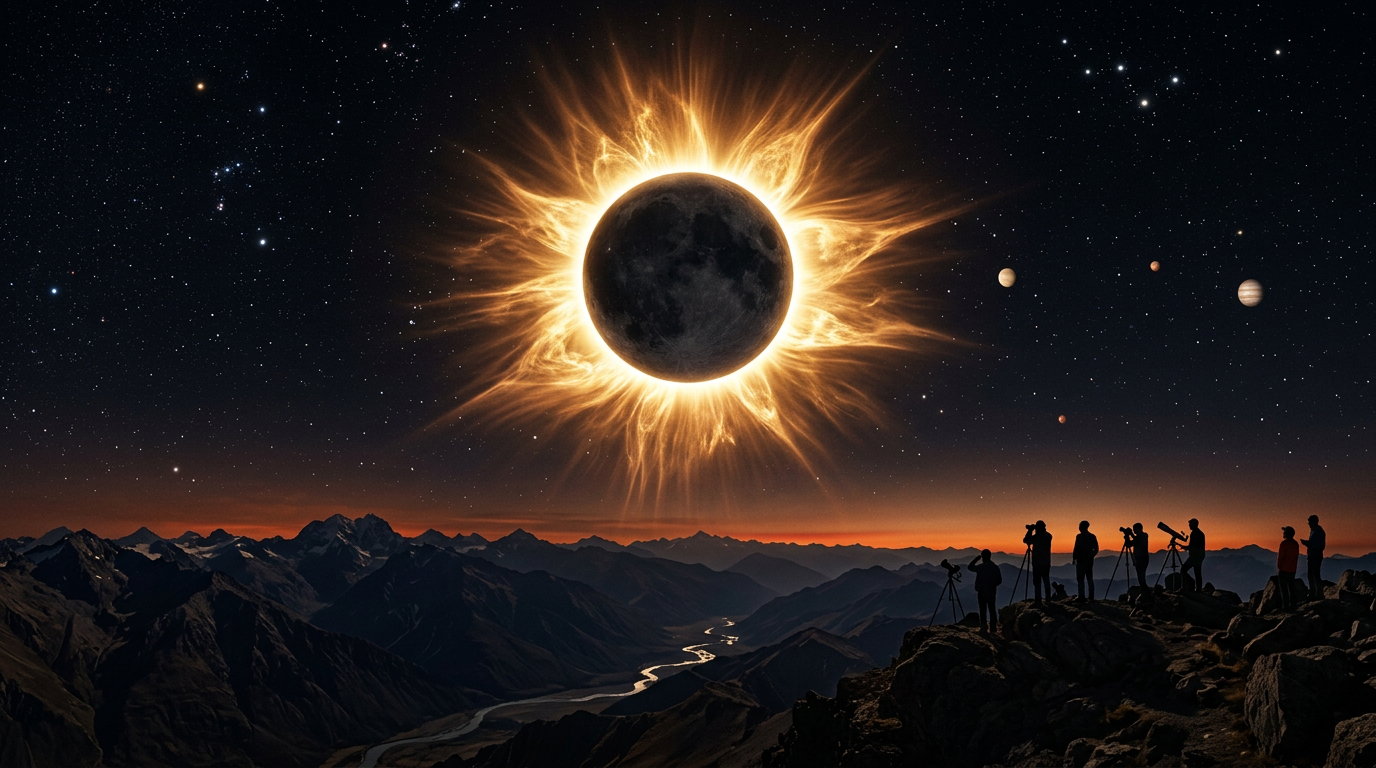
Solar Eclipse: Portals of Change and New Beginnings
Few astronomical experiences inspire as much awe as a solar eclipse. Within minutes, the daytime sky darkens, the stars come out, animals grow confused and the world seems to stand still. It’s not hard to understand why cultures throughout history have seen them as omens of change.
From the perspective of psychological astrology, solar eclipses are not omens — they are thresholds.
What is a solar eclipse?
A solar eclipse happens when the new Moon passes between the Earth and the Sun, blocking its light totally or partially. Astronomically, it’s nature’s most perfect coincidence: the Moon, which is 400 times smaller than the Sun, is also 400 times closer, which makes them appear the same size in the sky.
Eclipses always occur near the Lunar Nodes — the points where the Moon’s orbit intersects the Sun’s ecliptic — which in astrology connects them directly to the axis of destiny and evolution.
The solar eclipse as an amplified New Moon
Astrologically, a solar eclipse is like a New Moon with the volume turned all the way up. All the qualities of the New Moon — beginnings, intention, sowing — are extraordinarily intensified.
But an element of rupture also comes in. Where a New Moon plants seeds gently, a solar eclipse can turn the soil over much more deeply. It isn’t always comfortable. Sometimes the beginning that an eclipse sets in motion first requires something to fall apart.
Which areas of life does an eclipse activate?
That depends on the sign in which the eclipse occurs and how it relates to your personal birth chart. An eclipse in Aries will activate themes of identity and autonomy. In Cancer, themes of family and home. In Scorpio, processes of deep transformation.
The house in your birth chart where the eclipse degree falls shows the area of life that may be activated: career, relationships, health, finances, spirituality.
Six-month windows
The effects of a solar eclipse are not usually instantaneous — although sometimes they are. Most often, they open a six-month window during which changes gradually unfold. The next eclipse (which happens roughly every six months) tends to close or put a new spin on what the first one opened.
This perspective is liberating: you don’t have to “do” anything specific during the eclipse. What you can do is pay attention to what’s moving.
How to prepare for a solar eclipse
Set your intentions clearly. The eclipse is a powerful manifestation portal — what you plant here can grow for months.
Watch for the signs. What conversations come up, which doors close or open, which people come into or leave your life around the time of the eclipse.
Avoid making irreversible decisions on impulse. Eclipse energy can create a sense of urgency. Give it a few days before acting out of reactivity.
Trust the process. Eclipses tend to bring exactly what you need, even if it isn’t what you expected. Life has its own timetables.
The sky that lives within you
Every solar eclipse is a reminder that we are part of a universe in constant motion and renewal. What the sky does outside, it also does inside. And sometimes, a moment of darkness is what ends up bringing the most light.