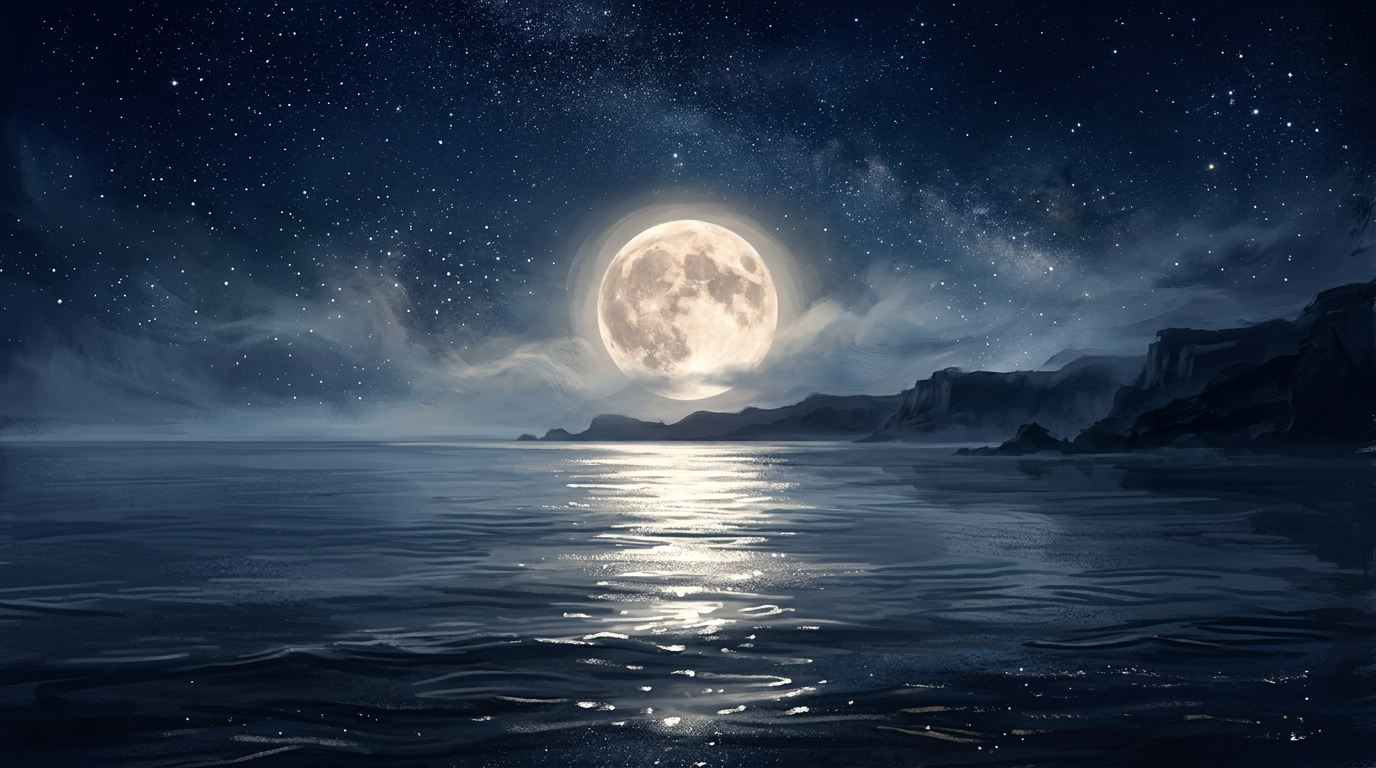
Full Moon: How to Make the Most of Its Energy
Twelve times a year — sometimes thirteen — the Moon reaches its fullness. It lights up the night with a power that has always fascinated humanity: artists have sung to it, farmers have respected it, sailors have navigated by it. And in astrology, the Full Moon speaks of a moment of culmination, revelation and release.
The lunar cycle as a living process
To understand the Full Moon, we need to understand the complete cycle. Each month, the Moon moves through all of its phases:
- New Moon: beginnings, setting intentions, starting in darkness.
- First Quarter: action, momentum, facing obstacles.
- Full Moon: culmination, maximum illumination, harvest or crisis.
- Last Quarter: review, gratitude, rest.
- Balsamic Moon: closure, letting go, preparing for a new cycle.
The Full Moon is the point of greatest tension and greatest light in this process. What was sown at the New Moon two weeks earlier is now revealed in full — with its light and its shadows.
The Sun-Moon opposition: the heart of the Full Moon
Astronomically, the Full Moon occurs when the Sun and the Moon are in exact opposition — 180 degrees apart. In astrology, oppositions represent polarities that call for integration.
Every Full Moon falls on an axis of opposite signs. For example:
- Full Moon in Taurus / Sun in Scorpio: the axis of material values and deep transformation.
- Full Moon in Aquarius / Sun in Leo: the axis of individuality and community.
The Moon illuminates what the Sun is working on. It’s as if the night reveals what the day has in hand.
The emotional dimension
The Moon rules our emotional world, the body, our instincts and memory. In its full phase, all of this is amplified. It’s normal to feel more emotional, more sensitive, even somewhat restless or sleepless. Processes we used to ignore rise to the surface.
From the perspective of psychological astrology, this increase in intensity is not a threat: it’s an opportunity to become aware of what usually operates beneath our surface.
How to work with the Full Moon
There’s no need for complicated rituals. Here are some simple yet powerful practices:
Write in your journal. Ask yourself: what has reached its peak in my life? What am I now seeing more clearly?
Identify what you want to let go of. The Full Moon is ideal for releasing habits, beliefs or situations that no longer serve you.
Rest and observe. Not everything has to be action. Sometimes the Full Moon simply asks you to stop and look.
Give thanks. The cycle of sowing and harvesting is also a cycle of gratitude. What has blossomed in your life that deserves recognition?
A lighthouse in the darkness
The Full Moon doesn’t solve problems: it illuminates them. And sometimes that’s exactly what we need — to see clearly what was hidden so we can consciously decide what to do with it.